Day 4 — Program & High-Assurance Verification
FMAIV: Formal Methods & AI-Assisted Verification
Taylor Johnson — Associate Professor of Computer Science, Computer Engineering & Electrical Engineering; Associate Dean for Graduate Education, College of Connected Computing · taylor.johnson@vanderbilt.edu · taylortjohnson.com
Ben Wooding — Postdoctoral Scholar, Institute for Software Integrated Systems · ben.wooding@vanderbilt.edu · woodingben.com
Vanderbilt University
Day 4 of 4
Day 4 — Programs & the Frontier
CBMC, Cryptol, SAW, and where the field is going
Run it live (no install): Codespaces (full toolset) or Colab — today’s notebook 04_day4_program_verif, plus the frontier NN notebooks 05_nn_robustness · 06_nn_mnist. All materials: https://github.com/ttj/fmaiv
Where we are
Three views of the same counter so far:
| Day | Model | Guarantee |
|---|---|---|
| 1 | Z3 / SMT formula | no counterexample of length ≤ N |
| 2 | nuXmv / SMV | no counterexample, ever (finite state) |
| 3 | Lean / induction | machine-checked proof, any bound |
Today: the same ideas, applied to real code.
Fresh from yesterday: an AI-discovered theorem, kernel-checked in a week
Day 3 closed on the AI proposes, the kernel disposes thesis — PFR, AlphaProof, DeepSeek-Prover. News from this week:
- The result. OpenAI’s research stack announced a disproof of Paul Erdős’ planar unit-distance conjecture (May 20, 2026) — a long-open extremal-geometry problem we flagged on Day 3 as generated but not yet formalized.
- Then. Logical Intelligence’s Aleph Prover delivered a public Lean 4 formalization (blog dated 2026-05-29) — i.e. ~9 days end-to-end — with professional mathematicians (Kevin Buzzard, Sergey Galkin, others) validating along the way.
- Scale. ~33,000 lines of Lean, ~252 Mathlib modules, conditional on two explicit class-field-theory inputs (Golod–Shafarevich + Shafarevich’s relation-rank bound) — reduced from ~30 open dependencies at the start.
- Provenance. Blog: https://logicalintelligence.com/blog/aleph-prover-erdos-disproof-lean-4-formal-methods; repo: https://github.com/logical-intelligence/erdos-unit-distance (Apache 2.0; Lean 4.29.1; CI runs
lake build+ externalleanchecker).
The Day-3 thesis, uncomfortably literal: an AI generated a candidate proof; a Lean kernel-checked artifact certified it in ~9 days. For comparison, PFR (also flagged on Day 3) took ~3 weeks with a Blueprint-coordinated team — the cycle time is shrinking. That cadence is the Day-4 frontier we’ll close on in L3.
Today’s roadmap
| Block | Topic |
|---|---|
| L1 | Bounded model checking of C with CBMC |
| L2 | Bit-precise specs with Cryptol; C↔︎spec equivalence with SAW |
| L3 | The frontier: neural-network verification + industrial deployments |
Learning objectives for Day 4
By the end of today you will be able to:
- Frame a C program as a transition system on memory states.
- Write a CBMC (C Bounded Model Checker) harness with nondeterministic inputs and read its counterexample.
- Write a small Cryptol spec and discharge a property with
:prove. - Explain how SAW (Software Analysis Workbench) proves a C implementation equivalent to a Cryptol spec.
- Locate the field’s frontier: NN verification, and where FM is deployed in industry.
L1 — Bounded model checking of C with CBMC
Programs are transition systems
A C program’s state is:
(\text{program counter},\ \text{valuation of every variable},\ \text{heap},\ \text{stack})
and its transition is “execute one statement.”
This is the same T = (S, S₀, →) from Day 1 — the state space is just much bigger.
What CBMC actually does
C source → goto-program → unwound goto-program → SAT/SMT formula → solver- Parse and simplify C into a control-flow “goto-program.”
- Unwind loops a fixed number of times.
- Encode every path as one big bit-precise formula.
- Ask the solver whether any path violates an assertion.
Same idea as Day 1 — CBMC turns C into a satisfiability query (it bit-blasts to SAT by default; --smt2 --z3 emits SMT for Z3 instead).
The pipeline, stage by stage
Caption: each CBMC stage lowers the program one level closer to a Boolean/bit-vector formula a solver can decide.
| Stage | What it does |
|---|---|
| goto-program | rewrite all control flow (if, for, while, ?:) into one uniform form: guarded gotos. Now there are no loops “shapes,” just jumps. |
| unwind | replace each loop by k copies of its body (Day-1’s bound, applied to code). |
| SSA | rename every variable so it is assigned once (x, then x_1, x_2, …). A program becomes a list of equations. |
| bit-blast | model each int as 32 individual bits; +, &, << become Boolean circuits — bit-precise. |
| solve | hand the formula to a SAT solver (MiniSat/CaDiCaL) by default, or to SMT (Z3/cvc5 via --smt2). SAT = a bug + trace; UNSAT = safe to depth k. |
The safety formula CBMC builds
For a loop unrolled to depth k, CBMC asks the solver one question:
\underbrace{I(s_0)}_{\text{start state}} \ \wedge\ \underbrace{\bigwedge_{i=0}^{k-1} T(s_i, s_{i+1})}_{k\ \text{steps of the program}} \ \wedge\ \underbrace{\bigvee_{i=0}^{k}\, \neg P(s_i)}_{\text{some step breaks } P}
Caption: bounded model checking unrolls the transition relation k times and asks whether the property can fail at any step.
- I = the initial condition; T = “execute one statement”; P = the property (your
assert, plus the built-in checks). - SAT (a solution exists) ⇒ there is a real run reaching a bad state — the counterexample.
- UNSAT (no solution) ⇒ no run of length ≤ k violates P — safe to depth k.
This is exactly the Day-1 bounded-model-checking encoding — only T is now extracted from C source automatically.
Loop unwinding
--unwind N— unfold each loopNtimes.--unwinding-assertions— CBMC checksNwas large enough and fails loudly if not. (CBMC 6 enables this by default; we write it explicitly to be clear.)- Off-by-one: a loop running
BOUND = 25times needs--unwind 26— one extra for the termination check.
The harness: nondeterminism + assertions
bool nondet_bool(void);     // CBMC: returns an unconstrained value

int main(void) {
    struct state s = { .mode = MODE_OFF, .x = 0 };
    for (int i = 0; i < BOUND; ++i) {
        bool press = nondet_bool();   // environment picks each step
        counter_step(&s, press);
        assert(s.x <= 10);            // the property
    }
}nondet_*()= the SMV “free input” idiom, in C.__CPROVER_assume(c)constrains inputs;assert(c)states the property.
Live demo: the counter in C
void counter_step(struct state *s, bool press) {
    if (s->mode == MODE_OFF && !press)        { /* stay off */ }
    else if (s->mode == MODE_OFF && press)    { s->mode = MODE_ON; }
    else if (s->mode == MODE_ON && !press && s->x < COUNT_MAX) { s->x++; }
    else if (s->mode == MODE_ON && (press || s->x >= COUNT_MAX)) {
        s->mode = MODE_OFF; s->x = 0;
    }
}
Same four guards as SMV next(...), Lean next, Z3 step(). (this is counter.c + counter_check.c)
cbmc counter.c counter_check.c --unwind 26 --unwinding-assertions
→ VERIFICATION SUCCESSFULReading a CBMC counterexample
Weaken the assertion to s.x < 10 and re-run:
[main.assertion.1] file counter_check.c line 57 assertion s.x < 10: FAILURE

State ... counter.c function counter_step
  prev_x = 9
State ... counter.c
  s.x = 10
Violated property: s.x < 10
CBMC prints the exact state sequence — and the precise press inputs — that drive x to 10.
Reading a trace step by step
A CBMC trace is a list of state updates in execution order. Read it like a debugger replay:
State 12 file counter_check.c line 49     s = { .mode = OFF, .x = 0 }   ← initial
State 18 file counter_check.c line 52     press = TRUE                  ← input chosen
State 24 file counter.c      line 41      s.x = 1                       ← step 1
   ⋮   (CBMC chooses press, x climbs 1,2,…,9)
State 71 file counter_check.c line 52     press = FALSE
State 77 file counter.c      line 41      s.x = 10                      ← step 10
Violated property: counter_check.c line 57 s.x < 10- Each
State …line is one assignment; the inputs (press = …) are the part you replay. - The last block names the violated property and its source line — the smoking gun.
- Replaying just the
pressvalues in a debugger reproduces the bug deterministically.
For a more readable view of the same trace — input column highlighted, x shown as a bar chart, transitions annotated — pipe cbmc --trace through scripts/cbmc-trace-replay.py:
Worked example: array_max + its counterexample
int array_max(const int *a, int n) {
    int m = a[0];
    for (int i = 1; i < n; ++i)
        if (a[i] > m) m = a[i];
    return m;
}
Harness: fill a[0..4] with nondet_int(), then assert the full spec of “maximum”: m >= a[i] for all i and m equals some a[i].
cbmc array_max.c array_max_check.c --unwind 6 --unwinding-assertions
→ VERIFICATION SUCCESSFUL
Now inject a bug — change the loop to i < n - 1 (skips the last element):
[main.assertion.1] line 37 assertion m >= a[i]: FAILURE
  a[0]=0  a[1]=0  a[2]=0  a[3]=0  a[4]=1     ← last element is the biggest…
  m = 0                                       ← …but the loop never looked at it
Violated property: m >= a[i]
CBMC hands you the smallest array that exposes the off-by-one. (this is array_max.c + array_max_check.c)
Worked example: the binary-search overflow
The famous JDK bug (publicized 2006): the midpoint of a binary search.
int mid = (lo + hi) / 2;        // BUG: lo + hi can overflow int
int mid = lo + (hi - lo) / 2; // SAFE: never overflows- For large indices,
lo + hiexceedsINT_MAXand wraps to negative — thena[mid]is an out-of-bounds read. - CBMC’s default overflow + bounds checks catch this without any assertion you write:
[binsearch.overflow.1] arithmetic overflow on signed + in lo + hi: FAILUREThe overflow-safe form verifies clean. Same class of bug as Ariane 5 (Day 1) — a conversion/arithmetic overflow that testing missed for years. (this is binsearch.c + binsearch_check.c)
What CBMC catches by default
Even with no assertions you write, CBMC checks for:
- integer overflow (the Ariane 5 bug),
- array out-of-bounds,
- pointer safety (null / invalid dereference, dereference of freed memory) via
--pointer-check, - division by zero.
Each is a built-in assertion; the counter run shows dozens of SUCCESS lines for these.
CBMC as a unit-test generator: --cover
So far we used CBMC to prove asserts. The same solver can do the opposite — find an input for every coverage goal you name:
cbmc gcd.c gcd_check.c --cover branch    --unwind 11    # one input per branch
cbmc gcd.c gcd_check.c --cover decision  --unwind 11    # one input per decision outcome
cbmc gcd.c gcd_check.c --cover mcdc      --unwind 11    # MC/DC (DO-178C avionics-grade)
cbmc gcd.c gcd_check.c --cover location  --unwind 11    # one input per source line
For every unreachable goal CBMC prints FAILED (dead code); for every reachable goal it prints SATISFIED along with the concrete inputs that hit it — exactly what a unit-test runner needs (CPROVER manual, test-suite generation and standard checks; tool source: https://github.com/diffblue/cbmc).
| Coverage criterion | Captures |
|---|---|
location |
every source line is reached |
branch |
every if/while/for decision goes both ways |
decision |
every compound boolean expression evaluates true and false |
mcdc |
every atomic condition is independently shown to affect the outcome — the standard for DO-178C Level A avionics |
The shift: “prove the assertion” and “generate one test per goal” are the same SAT/SMT query with different objective formulas. One tool, two modes.
Worked example: branch coverage for GCD
The Euclidean GCD function from Day 2 (gcd_01.smv), now in C as gcd.c + gcd_check.c:
One harness, two CBMC runs. Property mode proves the spec for every (a, b) in [0, 20]^2; coverage mode generates one unit-test input per branch:
$ cbmc gcd.c gcd_check.c --unwind 11 --unwinding-assertions
  → VERIFICATION SUCCESSFUL                                              # property mode

$ cbmc gcd.c gcd_check.c --cover branch --unwind 11
  [gcd.coverage.1]    line 28 function gcd entry point: SATISFIED        # 10 goals,
  [gcd.coverage.2]    line 28 block 1 branch false:     SATISFIED        # one
  [gcd.coverage.3]    line 28 block 1 branch true:      SATISFIED        # SATISFIED line
  [main.coverage.1-7] line 26-43 ...                    SATISFIED        # per branch
  ** 10 of 10 covered (100.0%)                                           # ← every branch hit
Each SATISFIED line carries the concrete (a, b) pair the solver found — that pair becomes one unit test. Counter example (counter_check.c) works the same way: --cover branch enumerates the press sequences that hit each of counter_step’s four guards.
The complement to CBMC: deductive verification
CBMC is bounded — it checks every run up to depth N. The other major style proves correctness for all inputs and all depths — the price is that you supply the invariants.
- Hoare triple \{P\}\;c\;\{Q\}: if precondition
Pholds andcterminates, postconditionQholds. - The creative work is the loop invariant (true on entry, preserved each iteration); add a variant (a measure that strictly decreases) to also prove termination — partial vs total correctness.
- You write
requires/ensures/invariant; an SMT solver discharges the proof obligations — Day 1’s Z3, finally cashed out on real code. - Tools: Dafny (gentlest, web IDE), Verus (verifies Rust — squarely on the AI-generated-code thesis), Frama-C, Why3, Viper.
Two complementary guarantees: CBMC finds bugs fast (bounded, push-button); deductive verification proves everything (unbounded — you write the invariant).
L1 recap
- A C program is a transition system on memory; CBMC builds it from source.
- CBMC = C → goto-program → unwound → SAT/SMT → solver (Day 1’s decision procedure, automated; SAT by default, Z3 optional).
- Harness with
nondet_*()+assert+__CPROVER_assume;--unwind Nbounds loops (CBMC 6 checksNis big enough by default). - Default checks catch overflow, bounds, null deref, division-by-zero for free.
☕ Break
We resume after the break with Cryptol and SAW.
L2 — Cryptol + SAW
Why a separate specification language
CBMC checks code against inline assertions. But often you want:
- a reference spec independent of any implementation, and
- a proof that a fast/tricky implementation equals the spec on all inputs.
“Spec once, verify many implementations.” This is Cryptol (Galois, first published 2003) + SAW.
What is Cryptol?
A small functional language for writing executable specifications of algorithms that work on bits and bytes — built by Galois, first published 2003, originally for cryptography.
- You write what the algorithm computes, at the bit level — not how to make it fast.
- The same file is both runnable (test it) and provable (
:provechecks it for all inputs). - Think “executable math for bit-vectors”: if you can write AES on a whiteboard, you can write it in Cryptol almost line-for-line.
Why it matters today: it’s the cleanest place to see “spec = proof target,” and it’s how AWS verifies real crypto (later this block).
Cryptol types are sizes — read [n]T as “n of T”
Every type carries a size, checked at compile time. That bit-exactness is why Cryptol is the language for crypto and hardware specs.
| You write | You say | It means |
|---|---|---|
Bit |
“bit” | one bit (a Boolean) |
[8] |
“8 bits” | an 8-bit word (= [8]Bit) |
[16][8] |
“16 of 8-bit” | 16 bytes (a 16-byte buffer) |
[4][8] |
“4 of 8-bit” | 4 bytes |
(A, B) |
“a pair” | a tuple of an A and a B |
A -> B -> C |
“a function” | takes an A and a B, returns a C |
- The number is the length, and it’s part of the type — so the compiler always knows every size.
- That’s why
[8] + [8]type-checks but[8] + [4]is a compile error. - Multiple arrows = multiple arguments:
[8] -> [N][8] -> [N][8]takes a key byte and a message.
Cryptol by example: a shift cipher
type N = 16                           // message length, in bytes ([N][8] = N bytes)
encrypt : [8] -> [N][8] -> [N][8]     // key byte -> 16 bytes -> 16 bytes
encrypt k msg = [ c + k | c <- msg ]  // add the key to every byte (+ is mod 256)

decrypt : [8] -> [N][8] -> [N][8]
decrypt k ct  = [ c - k | c <- ct ]

property roundtrip k msg = decrypt k (encrypt k msg) == msg
type N = 16names a compile-time size — usable anywhere a length is needed.[ c + k | c <- msg ]is a comprehension: “for each bytecdrawn frommsg(<-), producec + k” — like building a new array by transforming each element.+/-on[8]are arithmetic mod 256 — the width lives in the type.- a
propertyis a claim to check for all inputs. (this iscaesar.cry)
:check, :prove, :sat
caesar> :check roundtrip          -- fast: random testing, no solver
Using random testing.
passed 100 tests.
caesar> :prove roundtrip          -- exhaustive: ALL keys × ALL 16-byte messages
Q.E.D.
caesar> :sat \k msg -> decrypt k (encrypt k msg) != msg
Unsatisfiable
:check p— quick random sanity test (no solver), great before the real proof.:prove p— “pholds for all inputs”;Q.E.D.= proved exhaustively.:sat e— find inputs makingetrue;Unsatisfiable= none exist. (\k msg -> eis an anonymous function ofkandmsg.)
:prove p is exactly “¬p is unsatisfiable” — Day 1’s validity ↔︎ unsat-of-negation, now over fixed-width bit vectors. Cryptol talks to Z3 by default (through its SBV backend). (Run the caesar_starter.cry stub and :prove roundtrip returns a Counterexample instead.)
The counter in Cryptol (fifth encoding)
type State = (Bit, [4])           // (mode, x): [4] = 0..15, headroom to ask "x = 11?"

step : State -> Bit -> State
step s press = ...                 // four guards, mirrors counter.c

property bounded_invariant (presses : [25]Bit) =
    foldl (&&) True [ inv s | s <- states ]           // states = the 25-step trajectory

property inductive_invariant (s : State) (press : Bit) =
    if inv s then inv (step s press) else True          // mirrors Lean step
:prove bounded_invariant → Q.E.D. (~0.2s)
:prove inductive_invariant → Q.E.D. (~0.02s)(foldl (&&) True xs folds “and” across a list — “are all of xs true?”; states is the trajectory the file builds from presses.) (this is counter.cry)
SAW: tying Cryptol to a C implementation
The SAW example is popcount (count the set bits in a word): a clean Cryptol spec plus an optimized C implementation. SAW proves they compute the same function.
clang -c -emit-llvm -O0 -o popcount.bc popcount.c   # C → LLVM bitcode
saw popcount.saw                                     # prove C == Cryptol spec
Proof succeeded! popcount_loopSAW extracts a symbolic model of each C function from LLVM bitcode and proves it equivalent to the Cryptol spec, over all inputs, via SMT.
How SAW works: symbolic execution
Caption: SAW turns both the compiled C and the Cryptol spec into formulas over the same symbolic input, then asks the solver if they are equal for every input.
- Compile C to LLVM bitcode (
clang -emit-llvm) — the same intermediate form the compiler optimizes; SAW reads that, not the text. - Run the function on a symbolic input — a variable standing for all bytes at once, not one number. SAW threads it through the code and gets the output as a formula of the input bits.
- Compare to the spec. The Cryptol spec is already a formula. SAW asks the solver: “are these two formulas equal for every input?”
- UNSAT of the difference ⇒ equivalent. Same validity = unsat-of-negation logic as Days 1-3.
A .saw script, annotated
import "popcount.cry";                       // bring in the Cryptol spec
m <- llvm_load_module "popcount.bc";         // load the compiled C

llvm_verify m "popcount_loop" [] false (do {
    x <- llvm_fresh_var "x" (llvm_int 8);    // a SYMBOLIC 8-bit input (all bytes at once)
    llvm_execute_func [llvm_term x];         // call the C function on it
    llvm_return (llvm_term {{ (zero : [4]) # popcount_simple x }});  // result == spec (pad [4]→[8])
}) z3; // discharge with the z3 solverllvm_fresh_var= “an input standing for every value” (CBMC’snondet_*, in SAW).{{ … }}switches into Cryptol —popcount_simple xis the reference answer.- The script reads as a contract: given this symbolic input, after calling the function, the return equals the spec. (this is
popcount.saw)
The popcount example shape
Spec and implementation of the same function — “count the 1-bits”:
popcount_simple : [8] -> [4]              // Cryptol SPEC: sum the bits
popcount_simple x = sum [0 # [b] | b <- x]
uint8_t popcount_loop(uint8_t x) { // C IMPLEMENTATION
uint8_t count = 0;
for (int i = 0; i < 8; ++i)
count += (x >> i) & 1U; // tally bit i
return count;
}- One width mismatch to bridge: C returns
[8], the spec returns[4]. The script pads with four zero bits —(zero : [4]) # popcount_simple x— so the types line up. - SAW proves these are the same function on all 256 inputs: Proof succeeded! popcount_loop. (this is
popcount.cry+popcount.c)
Where SAW shines — and where it struggles
- Shines: crypto (AES, SHA, P-256), parsers, format validators, fixed-shape loops.
- Struggles: data-dependent loops (e.g. Kernighan’s
while (x != 0)) need explicit bounds — symbolic execution can’t always tell when to stop.
We grade only the counted-loop variant in SAW; the two Cryptol definitions are linked by :prove. A clean architecture beats fighting the tool.
L2 recap
- Cryptol = bit-precise spec language;
:prove/:satdischarge properties over all inputs via SMT. - SAW proves a C/LLVM implementation equivalent to a Cryptol spec.
- The counter’s bounded and inductive invariants both fall to Cryptol
:prove. - Match the obligation to the tool — fixed loops for SAW,
:proveto chain implementations.
☕ Break
We resume after the break with the frontier — neural-network verification and industrial FM.
L3 — The frontier
A stop sign + stickers = “Speed Limit 45”
A handful of printable stickers — not paint, not graffiti — on a real road sign make a deployed deep classifier read Speed Limit 45 in 84.8 % of drive-by video frames (Eykholt et al., Robust Physical-World Attacks on Deep Learning Visual Classification, CVPR 2018; https://arxiv.org/abs/1707.08945).
- Physical, not pixel-only: stickers printed, applied to the actual sign, photographed on a moving vehicle at varying distances and angles.
- The perturbation survives a real camera + lighting pipeline — no hand-crafted noise, no white-box gradient hidden in the JPEG.
- Why this drives formal robustness: testing some images cannot rule out attackers like this; we want a guarantee over a whole neighborhood of inputs around the true stop sign.
Verifying neural networks
The problem: given a trained network f and an input region R,
\forall x \in R,\ f(x)\ \text{still classifies correctly (robustness)}.
Here R is usually an ℓ∞ ball — every input within ε of a sample (each coordinate nudged by ≤ ε). Robustness = small input changes never flip the output class. Hard because f is non-convex (the safe region isn’t a simple shape, so checking corners is not enough), non-linear, and has millions–billions of activations.
A network is just a function
For verification, strip away the training story. A trained feed-forward / convolutional net is a fixed mathematical function f: \mathbb{R}^n \to \mathbb{R}^m:
f(x) = W_L\,\sigma(\cdots \sigma(W_1 x + b_1)\cdots) + b_L
- W_i = a weight matrix, b_i = a bias vector — just numbers fixed at training time.
- Each layer = matrix multiply, add bias, apply \sigma (the activation). Repeat for L layers.
- \sigma is usually ReLU (rectified linear unit): \sigma(z) = \max(0, z) — “pass positives through, zero out negatives.”
- For digit recognition: n = 256 pixels in, m = 10 class scores out; the answer is the argmax (the highest-scoring class).
So verifying a network = reasoning about a (big, non-linear) function — the same object we have reasoned about all week.
The robustness property, precisely
Given a correctly-classified input x_0 (say, an image of a 2), demand:
\forall x.\ \; \|x - x_0\|_\infty \le \varepsilon \;\Rightarrow\; \arg\max f(x) = \arg\max f(x_0)
- \|x - x_0\|_\infty \le \varepsilon = the ℓ∞ ball: every pixel may move by at most \varepsilon (brightness nudged up/down a little).
- The claim: every such nudged image still classifies as a 2 — no small perturbation flips the label.
- An x that does flip it is an adversarial example — the counterexample of NN verification.
This is a \forall-over-a-region property — Day 1’s “no bad input exists,” now over a continuous box of images.
ℓ∞ robustness is the canonical property, not the only one: the same machinery handles other input regions (rotations, NLP word-substitutions), output safety/reachability for control networks (ACAS Xu), and monotonicity/fairness — any “input-set ⇒ output-set” claim.
Why this is hard: ReLU explodes the cases
Each ReLU neuron is piecewise-linear — two linear pieces with a kink at 0:
Caption: each ReLU splits the input region into an “active” and “inactive” half; with k neurons that is up to 2^k linear regions.
- Per neuron, the input region splits into active (z>0) and inactive (z\le0) parts.
- With k ReLU neurons, that is up to 2^k linear regions — exponential blow-up.
- The safe set is therefore non-convex (not a simple box/ball) and non-linear overall.
- Exact ReLU verification is worst-case intractable: finding an adversarial example is NP-complete (Katz et al., Reluplex, CAV 2017); proving robustness — its complement — is co-NP-complete.
Two solver families
| (a) Bound propagation + branch-and-bound | (b) Set-based reachability | |
|---|---|---|
| Idea | compute linear lower/upper bounds on outputs; split cases when too loose | propagate a set through every layer; check the output set |
| ReLU handling | relax each ReLU to a linear envelope, tighten by branching | split the set at each kink; track exact/over-approx regions |
| Representative | α,β-CROWN (VNN-COMP winner) | NNV (our group) with star sets (Tran et al., FM 2019) |
| Verdict | bounds exclude bad outputs ⇒ robust | output set avoids the bad region ⇒ robust |
Both certify robustness the same way: UNSAT ⇒ no in-region input reaches a bad output.
A second axis — completeness vs. cost: incomplete methods (bound propagation) are fast but may answer “unknown”; complete methods add branch-and-bound to always decide, at higher cost. Winners run cheap-first, branch only where needed.
Reachability: push a set through the net
NNV’s recipe (our group) — verification as reachability (Tran et al., Star-Based Reachability Analysis of Deep Neural Networks, FM 2019):
\text{inputs } R \;\xrightarrow{\ \text{layer 1}\ }\; \cdot \;\xrightarrow{\ \text{layer 2}\ }\; \cdots \;\xrightarrow{\ \text{layer } L\ }\; \text{output set } f(R)
- Affine layers are easy: an affine map of a polytope (a flat-sided region like a box/polygon) is again a polytope (scale/rotate/translate a shape, get a shape). This handles every matrix-multiply + bias.
- ReLU layers split: the set may break into a union of polytopes (the 2^k blow-up) — the hard part. Exact reachability splits the set at each ReLU; the approximate star method over-approximates each ReLU (sound, may be incomplete) to scale to large nets.
- Check at the end: does f(R) intersect the unsafe region (a different class scores higher)? Empty intersection ⇒ robust.
The transition relation is the network itself — Day 1’s reachability, with layers as steps.
Star sets: making it scale
The blow-up is real — so the representation of the set is everything. NNV uses star sets.
- A star set compactly encodes a polytope as a center + basis vectors + a predicate (linear constraints) — “this shape = these directions, subject to these inequalities.”
- Closed under exactly the two operations NN verification needs: affine maps (for layers) and intersection with a half-space (everything on one side of a plane) — for the safety check.
- vs. zonotopes / interval / abstract-domain representations: stars carry far less over-approximation — we report 10×–10,000× speedups with less conservatism than DeepZ / DeepPoly / ReluVal (Tran et al., FM 2019).
- Less over-approximation = fewer spurious “maybe unsafe” verdicts (the false-positive problem from static analysis, again). The approximate star method stays sound (it never misses a real violation) but may be incomplete — those spurious verdicts are the price of scaling; the exact method splits each ReLU to recover completeness, at higher cost.
Caption: for the same true output set, looser representations (zonotopes) over-approximate badly; star sets stay tight.
Exact reachability in pictures: a 3-input / 2-output net
A canonical NNV demo — a small 3-input / 2-output ReLU MLP (~5 hidden layers), reachable output set computed exactly with star sets (Tran et al., FM 2019).
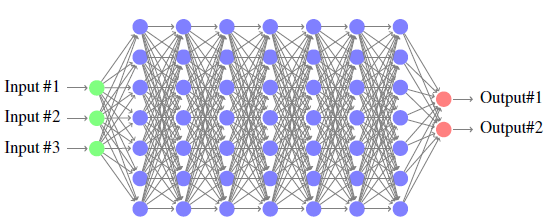
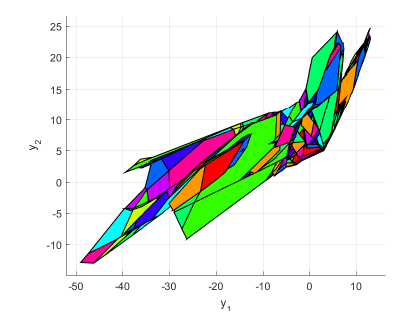
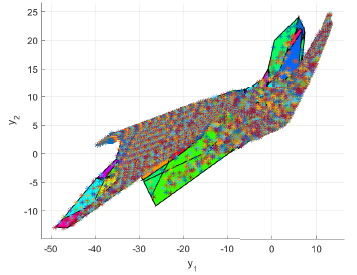
- Star sets keep the picture honest. Each colored region is one piece of the true output set produced by an exact ReLU split. The simulations confirm soundness (every sample is contained) and tightness (no empty slack).
- Our auto_LiRPA recreation in
notebook 05/compare_reachability.pyshows the bound-propagation complement: a rectangle (IBP / CROWN / α-CROWN) that contains this whole polygon — sound, cheaper, looser.
(Source: T. Johnson’s NNV lab — the exact 3-input / 2-output compareReachability benchmark; https://github.com/verivital/nnv/tree/master/code/nnv/examples/Tutorial/NN/compareReachability.)
MNIST robustness: set representations side by side
Scaling the picture to a real classifier — MNIST handwritten digits (10 classes, 28×28 inputs):
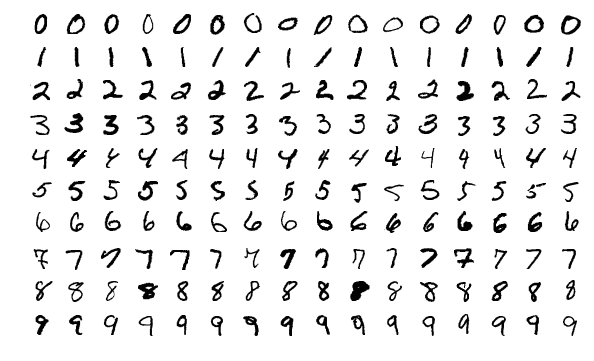
For each test image x_0, CROWN / ImageStar / α-CROWN all answer the same question — is every input in the ℓ∞ ε-ball classified the same way? — by propagating a set through the convolutional layers and projecting to ten output intervals [lo_j, hi_j] (one per class). Robustness holds iff:
lo_{\text{true}} \;>\; \max_{j \neq \text{true}} hi_j
- CROWN (
auto_LiRPA) — linear lower/upper bounds; ms-per-image on CPU. Our colab demo. - ImageStar (NNV; Tran et al., CAV 2020) — exact CNN reachability through Conv + AvgPool + BatchNorm + ReLU (uses exact ReLU splitting + the star-set representation).
- α-CROWN / β-CROWN — bound propagation + branch-and-bound → complete verifier; the VNN-COMP MNIST-FC champion.
Live in our stack: notebook 06 + verify_fc.py plot the per-class CROWN intervals for a single digit (the verify_fc.m analog from NNV) and compare CROWN vs IBP vs α-CROWN certified accuracy across 100 images.
(References: Tran et al., “Verification of Deep Convolutional Neural Networks Using ImageStars”, CAV 2020; MNIST dataset: http://yann.lecun.com/exdb/mnist/.)
NN verification in the wild
Real networks we have verified — beyond toy MLPs:
| System | Network | Property verified |
|---|---|---|
| ACAS Xu | 45 nets, 6×50 neurons each | collision-avoidance advisories stay correct in safe regions |
| VGG16/19 (ImageStar; Tran et al., CAV 2020) | 16–19 layers, ~140M params, ImageNet 1000 classes | robust (sound over-approximation) to a bounded ℓ∞ perturbation of an ImageNet image (≈10 min, 1 core) |
| CARLA / perception | conv nets on driving images | classification stable under ℓ∞ image noise |
| Closed-loop CPS (Lopez et al., NNV 2.0, CAV 2023; Verisig: Ivanov et al., HSCC 2019) | net + plant dynamics (ACC, cruise control) | the controlled system stays safe over time |
The frontier reach: from a 300-neuron advisory net to a 140-million-parameter image classifier, and from a bare network to a network-in-the-loop control system.
Where NN verification is being applied
A widening application surface — far beyond MNIST/CIFAR toys (sources: VNN-COMP 2020–2025 benchmark archive; NNV case-study log; Liu et al., Algorithms for Verifying Deep Neural Networks, Found. & Trends in Optimization, 2021):
| Domain | What is being verified | Representative benchmarks / references |
|---|---|---|
| Image classification | local ℓ∞ robustness of MLPs / CNNs / ResNets / ViTs | MNIST-FC, CIFAR-10/100, ImageNet (VGG-16/19 via ImageStar; Tran et al., CAV 2020), tinyimagenet, vit |
| Semantic / medical segmentation | per-pixel class stability of U-Nets | Carvana UNet (VNN-COMP 2022+); brain-MRI / lung-CT segmentation (Tran et al., FM 2021) |
| Speaker / audio recognition | invariance under bounded acoustic perturbations | Speaker-ID CNNs; VeriX explainability + verification on audio classifiers |
| Video classification | per-frame and short-horizon temporal stability of 3D-CNNs | UCF-style action-recognition robustness studies (Pal, Musau et al.) |
| Fairness in tabular ML | swaps in protected attributes never flip the label | FairSquare (Albarghouthi, OOPSLA 2017); DICE (Galhotra et al.); FairBoost |
| Aircraft collision avoidance | safe-advisory regions of policy nets | ACAS Xu (every VNN-COMP, 2020 →) |
| Autonomous-driving perception | sign-recognition + lane-detection invariance to noise | Traffic-Signs-Recognition (Erascu, Postovan; VNN-COMP’23); cctsdb_yolo, metaroom |
| Closed-loop CPS / RL | system-level safety with the network in the loop | NNV 2.0 (Lopez et al., CAV 2023); SafeRL (AFRL); CartPole, LunarLander |
| Database / ML-for-systems | bounded-error cardinality estimators, learned indexes | nn4sys (Lin et al., VNN-COMP 2022+) |
| LLM / VLM guardrails | property checks on small open LMs and content filters | AWS Bedrock Automated Reasoning; Shi et al., Robustness Verification for Transformers, ICLR 2020 |
Whenever the property fits the “input region ⇒ output region” shape from Day 1, the bound-propagation / reachability machinery transfers.
What works, what’s hard, what’s open
Capability is not just “parameter count” — it is layer × architecture × spec. Distilled from the VNN-COMP 2020–2025 benchmark archive + our AAAI’26 lab (https://vnn-comp.github.io/#aaai2026):
| Routinely verifiable today | Hard / partial | Open frontier | |
|---|---|---|---|
| Layers | Linear/Affine, Conv2D, ReLU, AvgPool, BatchNorm, ResNet skip-connections | MaxPool (per-neuron split), Sigmoid/Tanh (curved relaxations are loose), ConvTranspose, sigmoidal nn4sys heads |
Self-attention / multi-head, LayerNorm, Softmax, LSTM/GRU recurrence, dynamic shapes |
| Architectures | feed-forward MLPs, CNNs, small/medium ResNets, small ViTs, branched DAGs | Recurrent control (LSTM in the loop), U-Nets at full Carvana resolution | Large transformers, mixture-of-experts, LLMs, diffusion models |
| Sizes (one-shot robustness) | ≲ 10 M params with bound-prop + B&B; up to ~140 M (ImageStar / VGG-16/19) for reachability | 100 M – 1 B image models with heavy conservatism | LLMs (1 – 70 B+), VLMs, full agent stacks |
| Specs / input regions | ℓ∞ balls; safe-region reachability for control; halfspace output specs | ℓ2 / ℓ1 balls, rotations, brightness; discrete word-substitutions for NLP | semantic robustness across pixel-space and natural-language; “no jailbreak” |
| Verdict you can expect | sound + complete via branch-and-bound (α,β-CROWN) or exact star reachability | sound + incomplete — verifier returns unknown on the hard pieces | no mature sound verifier exists for the full frontier yet |
Rule of thumb (2025): “feed-forward / piecewise-linear / ℓ∞ / image scale” → solved; “recurrent / curved / discrete / language” → research.
VNN-COMP: the state of the art
Like SAT-/SMT-COMP, VNN-COMP is the field’s annual scoreboard — 6 editions through 2025 (the latest run under the SAIV symposium, co-located with CAV), tools standardized on ONNX (the network) + VNN-LIB (the spec).
- In routine reach: ReLU MLPs, CNNs, ResNets, small transformers; ℓ∞ robustness, reachability.
- Winner 2021–2025 — five straight years: α,β-CROWN, i.e. GPU-accelerated linear bound propagation + branch-and-bound — the configuration the strongest tools have converged on.
- Still open: large transformers / LLMs, recurrent nets, high-dimensional inputs, non-ℓ∞ specs.
(Results & benchmarks: https://vnn-comp.github.io/; the annual competition reports are linked there.)
The frontier: from images to language & autonomy
Our grand challenge — “Let’s verify ChatGPT”: what would we even verify, and how? (Johnson, Is Neural Network Verification Useful and What Is Next?, Allerton 2025.)
- Today’s reach: verifiers handle hundreds of millions of parameters (e.g. ResNets; our ImageStar VGG-16/19 work reaches ~140M) for ℓ∞ robustness of image classifiers — but parameter count alone isn’t a clean capability boundary (architecture, the spec, and completeness all matter as much as size).
- The needed shift: to NLP (sentiment, hate-speech, and guardrail models) and vision-language-action (VLA) robot policies — new architectures, new specs.
- A realistic near-term target: fully open small language models — Ai2’s OLMo2-1B, HuggingFace’s SmolLM2-135M — already near the scalability envelope, and the industry push to shrink models for cheap inference only helps.
- Beyond one network: neuro-symbolic systems — neuro-symbolic behavior trees (BehaVerify; Serbinowska & Johnson, SEFM 2022; Formalizing Stateful Behavior Trees, FMAS 2024) and neuro-symbolic automata (Sasaki, Lopez & Johnson, NeuS 2025) — compose NN verification with classical model checking; NNV 2.0 now also covers CNNs, neural ODEs, RNNs, and binary nets.
- Both directions: foundation models for verification (draft specs, models, act as oracles) and verification of foundation models.
Transformer Explainer: see what we’d have to verify
What is inside the model when we say “verify ChatGPT”? The Transformer Explainer (Cho et al., 2024; arXiv:2408.04619) is a browser-based, live interactive of GPT-2 — watch the embedding, attention heads, MLP blocks, and the softmax token sampler update as you type.
- Embedding + positional — a bag of float vectors, layer-norm’d. Robustness here is the easy part: bounded perturbations of a continuous vector.
- Self-attention (multi-head) — query/key/value matmul, then a softmax over key positions. This is the hard layer for verification — softmax is curved, attention is bilinear in inputs, and bounds blow up fast.
- MLP block — two affine layers + GELU. Sound bounds via CROWN-style relaxation; same family of techniques as Day-4 image-classifier verification.
- Output softmax — converts logits to next-token probabilities. The decision is the argmax (or a sample); the “robustness” question is on the distribution, not the argmax — a brand-new specification problem.
The Explainer is a great teaching prop: every box you can click on is a layer some verifier needs to support. The honest answer to “what’s missing for Let’s Verify ChatGPT” is: sound bounds for attention + softmax, at billions-of-parameters scale, against a non-ℓ∞ specification on a discrete-token output. (Shi et al., Robustness Verification for Transformers, ICLR 2020, is the standing formal anchor — and it stops well short of full LLMs.)
Adversarial perturbations → LLM jailbreaks: the same family
The image attacks earlier (Eykholt’s stickers, our PGD demo) and “LLM jailbreaks” are the same algorithm family in different metric spaces.
| Image classifier (PGD) | LLM guardrail (GCG) | |
|---|---|---|
| Substrate | continuous pixels in [0,1]^d | discrete token sequence |
| Constraint | \ell_\infty ball of radius \varepsilon | suffix of k tokens appended to a prompt |
| Objective | minimize true-class margin | maximize probability of a forbidden completion |
| Algorithm | gradient sign + project (Madry et al., ICLR 2018) | GCG: greedy coordinate descent on token logits (Zou et al., 2023; arXiv:2307.15043) |
| State of the art | falsifier; verifier exists (α,β-CROWN, NNV) | falsifier; no mature sound verifier |
Demo: day04/examples/nn/adversarial_demo.py — FGSM (Goodfellow et al., ICLR 2015) and PGD on a small ReLU MLP. Watch each attack flip the prediction as \varepsilon grows; PGD is strictly stronger than FGSM at the same budget (the script asserts this as a sanity check).
The takeaway for the audience: generating an attack is easy; proving none exists is the open problem. That asymmetry is exactly the soundness ↔︎ completeness gap from the whole week, and it is the reason this is still a research field.
Neural-network verification: the literature
Fact-checked entry points — the spine of the field:
- Hardness & first solver — Katz et al., Reluplex, CAV 2017 (exact ReLU robustness is NP-complete); modern successor Marabou 2.0, Wu et al., CAV 2024.
- Family (a): bound propagation + B&B — CROWN (Zhang et al., NeurIPS 2018) → α-CROWN (Xu et al., ICLR 2021) → β-CROWN (Wang et al., NeurIPS 2021) → GCP-CROWN (Zhang et al., NeurIPS 2022).
- Family (b): reachability / abstract domains — AI2 (Gehr et al., IEEE S&P 2018); DeepZ (NeurIPS 2018) & DeepPoly (Singh et al., POPL 2019); NNV star sets (Tran et al., FM 2019), ImageStar (CAV 2020), NNV 2.0 (Lopez et al., CAV 2023); Verisig for NN-controlled hybrid systems (Ivanov et al., HSCC 2019).
- Books / surveys — Albarghouthi, Introduction to Neural Network Verification (free at verifieddeeplearning.com); Liu et al., Algorithms for Verifying Deep Neural Networks, Found. & Trends in Optimization, 2021.
- Hands-on tutorials — our AAAI’26 VNN-COMP tutorial (slides + Google Colab notebooks): https://vnn-comp.github.io/#aaai2026; and the AAAI-2022 NN-verification tutorial (auto_LiRPA, α,β-CROWN Colabs) at neural-network-verification.com.
- Frontier — Shi et al., Robustness Verification for Transformers, ICLR 2020 — the formal anchor; full LLMs remain out of sound-verification reach.
Classical FM in production: AWS
AWS Provable Security runs formal methods at production scale:
- s2n-TLS — crypto kernels (HMAC, DRBG) verified with SAW against Cryptol specs (the L2 workflow), every commit.
- s2n-bignum — verified assembly (P-256/384/521, X25519, Ed25519, RSA, AES-XTS), each with a HOL Light proof, per commit.
- Cedar — authorization policy language specified in Lean (Day 3; originally Dafny).
Classical FM in production: everyone else
- Semiconductors — Cadence JasperGold, Synopsys VC Formal (Apple, Intel, AMD, ARM).
- Verified systems — seL4 (microkernel, Isabelle), CompCert (C compiler, Coq).
- Avionics / space — SCADE & Astrée (Airbus fly-by-wire), SPARK/Ada (Ariane 6).
- Microsoft — Dafny, Boogie, Z3 across Azure and Windows components.
One shape behind CBMC, SAW, and NN verification
Three very different Day-4 tools, one mental model — compile the artifact to a formula, hand it to a solver:
| Tool | Artifact | Formula it builds | Solver |
|---|---|---|---|
| CBMC | C program + assertion | loops unrolled → SAT/SMT | SAT / Z3 |
| SAW | C/LLVM vs Cryptol spec | symbolic execution → “impl = spec?” | SAT / SMT |
| α,β-CROWN / NNV | network + ℓ∞ ball | bounds / reachable set → “bad output reachable?” | LP / MILP (linear / mixed-integer programming) / SMT |
Each asks the solver the same question — is a bad behavior satisfiable? — and reads UNSAT as a proof. It is the Day-1 move (assert the negation) wearing three costumes.
Where formal methods meets AI
The convergence, both directions:
- FM for AI — verify neural networks (α,β-CROWN, NNV) and gate agent/LLM outputs (AWS Bedrock Automated Reasoning).
- AI for FM — LLMs draft and repair proofs, specs, invariants, and harnesses: retrieval-augmented proving (LeanDojo / ReProver, Lean Copilot), AlphaProof (IMO-medal level), DeepSeek-Prover, and autoformalization (natural language → Lean).
- How we know it works — benchmarks: miniF2F / ProofNet / PutnamBench (proving), VERINA (verifiable code-gen), SV-COMP (software), VNN-COMP (neural nets) — the field’s honest scoreboards.
- The constant: a trusted checker (SMT kernel, Lean kernel) arbitrates. AI proposes; the kernel disposes — and a benchmark says by how much.
How do we know it works? Evaluating AI + FM
If AI proposes and a kernel disposes, measuring progress means counting what the kernel accepts — never what merely looks plausible.
- pass@k — give the model
ktries; a problem counts as solved only if some attempt is accepted by the checker (Lean kernel, SMT proof, SV-COMP validator). No credit for plausible-looking text. - Benchmarks are the scoreboard:
| Benchmark | Domain | Measures |
|---|---|---|
| miniF2F / PutnamBench | competition & undergrad math | kernel-accepted proofs (pass@k) |
| SV-COMP | C software | correct verdict + machine-checked witness |
| VNN-COMP | neural networks | proved/disproved robustness; standardized ONNX + VNN-LIB |
“Don’t trust — verify.” An LLM’s Lean proof of a hard problem isn’t read for plausibility; it is fed to the kernel. Accepted ⇒ it counts. That is how we know.
The week in one table
| Day | Tool | Question answered |
|---|---|---|
| 1 | Z3 + SMT-LIB | counterexample of length ≤ N? — bounded refutation |
| 2 | nuXmv | counterexample ever? — full model checking |
| 3 | Lean 4 | why no counterexample? — inductive proof |
| 4 | CBMC + Cryptol/SAW | does the source match the spec? — implementation-level |
Same counter, five encodings, four kinds of guarantee.
L3 recap
- Neural-network verification (α,β-CROWN, NNV) verifies the AI systems themselves; VNN-COMP tracks the frontier.
- Industry runs FM at scale — AWS (SAW/Lean/Z3), chips (JasperGold), verified systems (seL4, CompCert).
- FM ↔︎ AI converge, with a trusted checker always arbitrating.
Wrap + work
Day 4 — and the week — in one slide
- Programs are transition systems; CBMC verifies real C with Day-1’s engine.
- Cryptol specs + SAW prove implementations equal their specs, over all inputs.
- The frontier: verifying neural networks; the reality: FM in production everywhere.
- The constant across four days: AI proposes, the kernel disposes.
What you can do now
You can:
- Encode a system as a transition system.
- Specify correctness in propositional, temporal, or higher-order logic.
- Discharge it via SAT/SMT, model checking, or theorem proving.
- Connect the spec to real code via CBMC and Cryptol/SAW.
- Drive AI assistants in the loop, with the kernel as truth.
Where to go next — beyond this week
A 4-day intensive samples; here’s the rest of the map, with courses that go deep (annotated list in the repo README):
- Deductive verification, deeper — we introduced contracts + loop invariants today; go further into separation logic (the heap, aliasing, concurrency) and full functional correctness with Dafny, Verus (verifies Rust), Frama-C, Why3, Viper. (CMU 15-414, ETH Program Verification.)
- Program synthesis — the dual of verification: SyGuS, Rosette. If generation is cheap, synthesize-then-verify is the natural pairing. (Berkeley 219C, OPLSS.)
- Verified-stack tradition (Coq/Rocq, Isabelle) — CompCert (C compiler), seL4 (microkernel): the largest machine-checked artifacts. (DeepSpec, MIT FRAP.)
- Probabilistic & hybrid model checking — PRISM; nuXmv’s infinite-state/IC3 and hybrid modes. (Oxford CAV.)
- Protocol verification — Tamarin, ProVerif, CPSA (Cryptographic Protocol Shape Analyzer, MITRE) for crypto protocols (vs. SAW’s implementation proofs). (SRI SSFT.)
- Evaluating AI + FM — the scoreboards: miniF2F (proofs), VNN-COMP (NN), SV-COMP (C). The highest-value skill for the agentic era.
In-session exercise
Pick a track (see assignments/day04.md):
- CBMC: write a small C function + harness (saturating counter, queue,
my_abs); verify a property; introduce a bug and capture the counterexample. - Cryptol/SAW: write a small spec (4-bit cipher, parity, CRC-4) with two definitions;
:provethey agree.
Each topic ships a _starter stub (which produces a counterexample) plus a worked solution — start from the starter and fix it until the verdict is clean.
Homework + survey (ungraded, for depth)
- Finish your chosen track to a clean verdict; capture one counterexample.
- Survey paragraph — pick one: latest VNN-COMP (what’s in reach for α,β-CROWN?), AWS Provable Security s2n (what’s continuously verified, with what stack?), or one thing in your research that is / isn’t a fit for FM.
References for Day 4
- Clarke, Kroening, Lerda. A Tool for Checking ANSI-C Programs, TACAS 2004 (the original CBMC paper; lead/maintainer Daniel Kroening).
- Lewis, Martin. Cryptol: High Assurance, Retargetable Crypto Development, MILCOM 2003.
- Galois — Cryptol & SAW docs/tutorials; AWS Provable Security blog.
- VNN-COMP — https://vnn-comp.github.io/; α,β-CROWN; NNV (verivital). Hands-on AAAI’26 VNN-COMP tutorial (ours — slides + Google Colab notebooks): https://vnn-comp.github.io/#aaai2026.
- NN-verification reading — Katz et al. Reluplex (CAV 2017); Tran et al. NNV / star sets (FM 2019; ImageStar CAV 2020; NNV 2.0 CAV 2023); Albarghouthi, Introduction to NN Verification (free); Liu et al. survey (FnT Optimization 2021).
- Frontier / next directions — Johnson, Is Neural Network Verification Useful and What Is Next? (Allerton 2025, hdl 2142/130315); Serbinowska et al. BehaVerify / neuro-symbolic behavior trees (verivital/behaverify); Belcak et al. Small Language Models are the Future of Agentic AI (arXiv 2506.02153).
- AWS Cedar (Lean spec); seL4, CompCert (verified systems).
Full list + competitions table: repo README.md.
Thank you
Four days, four pillars, one counter, five encodings.
Repo: github.com/ttj/fmaiv — all slides, examples, the Docker toolchain, and references.
Questions, and where to go next: the reading list and communities in the README.